
This is a post about color palettes for branding, but before you think I’m about to do the whole “blue means trust, red means passion, green means nature, pink means feminine” thing… absolutely not.
That version of color psychology is so dumbed down that it’s basically useless.
Because even just using blue as the easiest example: blue can mean a hundred different things depending on what kind of blue we’re talking about. A really earthy blue feels completely different from a soft pastel blue, which feels completely different from a digital-bright blue. Same hue family, totally different message.
One might feel mature, grounded, expensive, a little gallery-wall, ocean-at-dusk, old-denim energy. Another might feel soft, sweet, skincare-ish, gentle. Another might feel techy, optimistic, energetic, startup, sporty, loud.
And they are all blue.
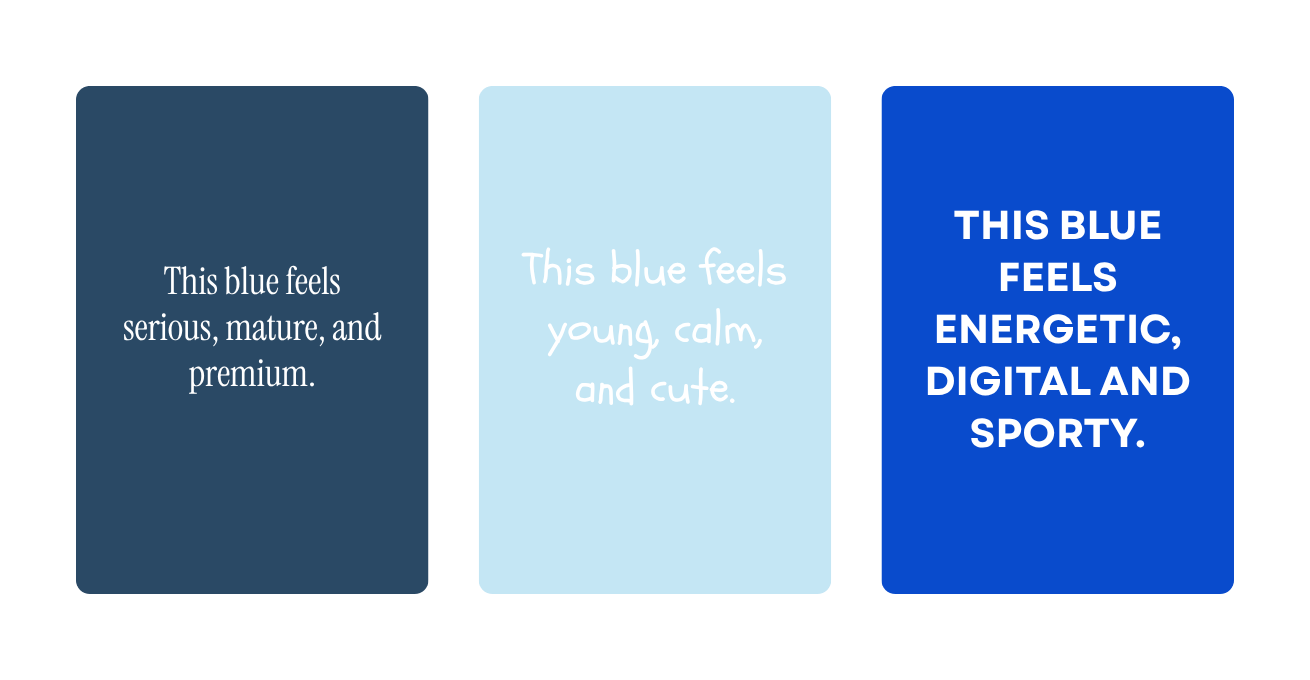
So no, the hue you choose does not magically communicate your whole brand personality. Color is way more nuanced than that. But also, it’s not as complicated as people make it feel once you understand a few things.
Don’t pick colors before you know what they’re for
A good color palette needs to work outside of the swatch preview.
Before you choose any of the colors, think about what each one will actually be used for:
- backgrounds,
- text,
- buttons,
- section backgrounds,
- documents
- borders,
- stationery/packaging,
- small accent moments.
Every color needs a role.
If your palette has five pretty colors but none of them can work as a button, or none of them have enough contrast for a chunk of text that sits on top of an image background, it’s not a good color palette. It might look beautiful, but it won’t be useful.
That’s why my rule of thumb is:
You need:
- a background color,
- a text color,
- a strong accent color,
- and one or two supporting colors.
The goal is not just to make the palette look good together. The goal is to make sure the colors can actually build a brand, a website, and a clear visual hierarchy.
The better version of color psychology
The boring version says:
Blue = trust.
Red = passion.
Green = nature.
Pink = feminine.
The better version says:
Color meaning comes from hue, saturation, brightness, contrast, context, and usage.
And honestly, the only color model you really need to understand for this is HSB — hue, saturation, and brightness.
No need to overcomplicate it with hex codes, color wheels, or anything overly technical. HSB is actually super intuitive once you start playing with it.
H = Hue
Hue is the actual color family.
Red, yellow, green, blue, purple, etc.
Values: 1–360
S = Saturation
Saturation is how pigmented, intense, or muted the color feels.
Low saturation = softer, more muted.
High saturation = stronger, brighter, more intense.
Values: 1–100
B = Brightness
Brightness is how light or dark the color is.
Low brightness = darker.
High brightness = lighter.
Values: 1–100
I embedded little HSB sliders here so you can actually play with the colors yourself, because once you see it visually, it clicks so fast.
Try out the interactive HSB slider below to see how hue, saturation, and brightness affect the feeling of a color.
You can take the same blue and make it feel earthy, baby-soft, electric, corporate, coastal, premium, childish, clinical, calm, cheap, or editorial — just by shifting the saturation and brightness.
That’s why “blue means trust” is such a lazy way to talk about brand colors.
It’s not completely useless, but it’s branding kindergarten. The real meaning comes from the exact version of the color, what it’s paired with, and how it’s actually used.
Common color categories & formulas you can use
Color psychology gets much clearer when you look beyond hue and pay attention to saturation and brightness too.
These ranges are not strict rules, but they’re helpful starting points when building a palette.
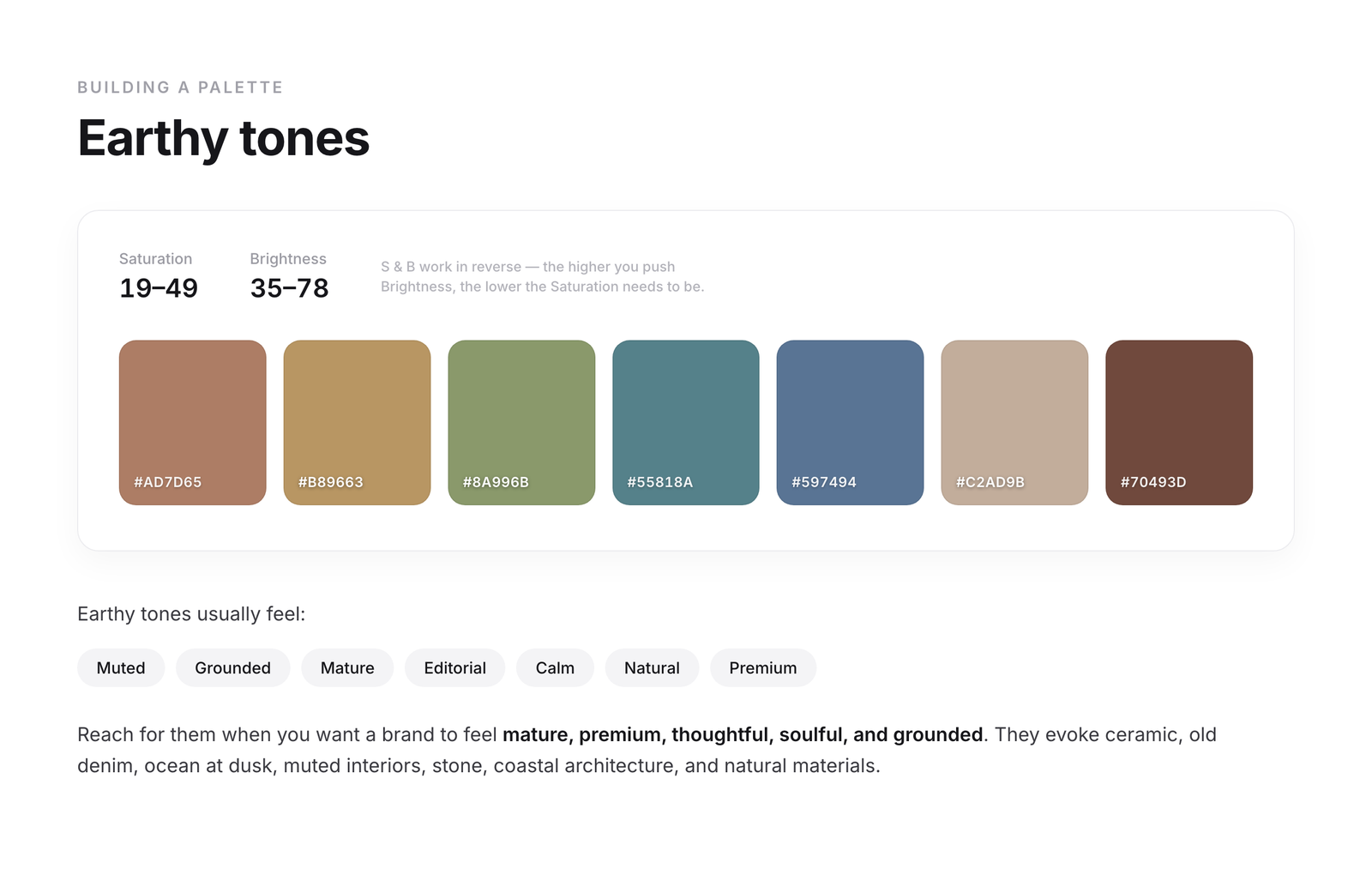
Earthy tones
Formula:
Saturation: 20–50
Brightness: 35–78
Earthy tones usually feel muted, grounded, mature, editorial, calm, natural, and more premium.
Use them when you want the brand to feel: mature, premium, thoughtful, soulful, grounded.
They give associations like ceramic, old denim, ocean at dusk, muted interiors, stone, coastal architecture, and natural materials.
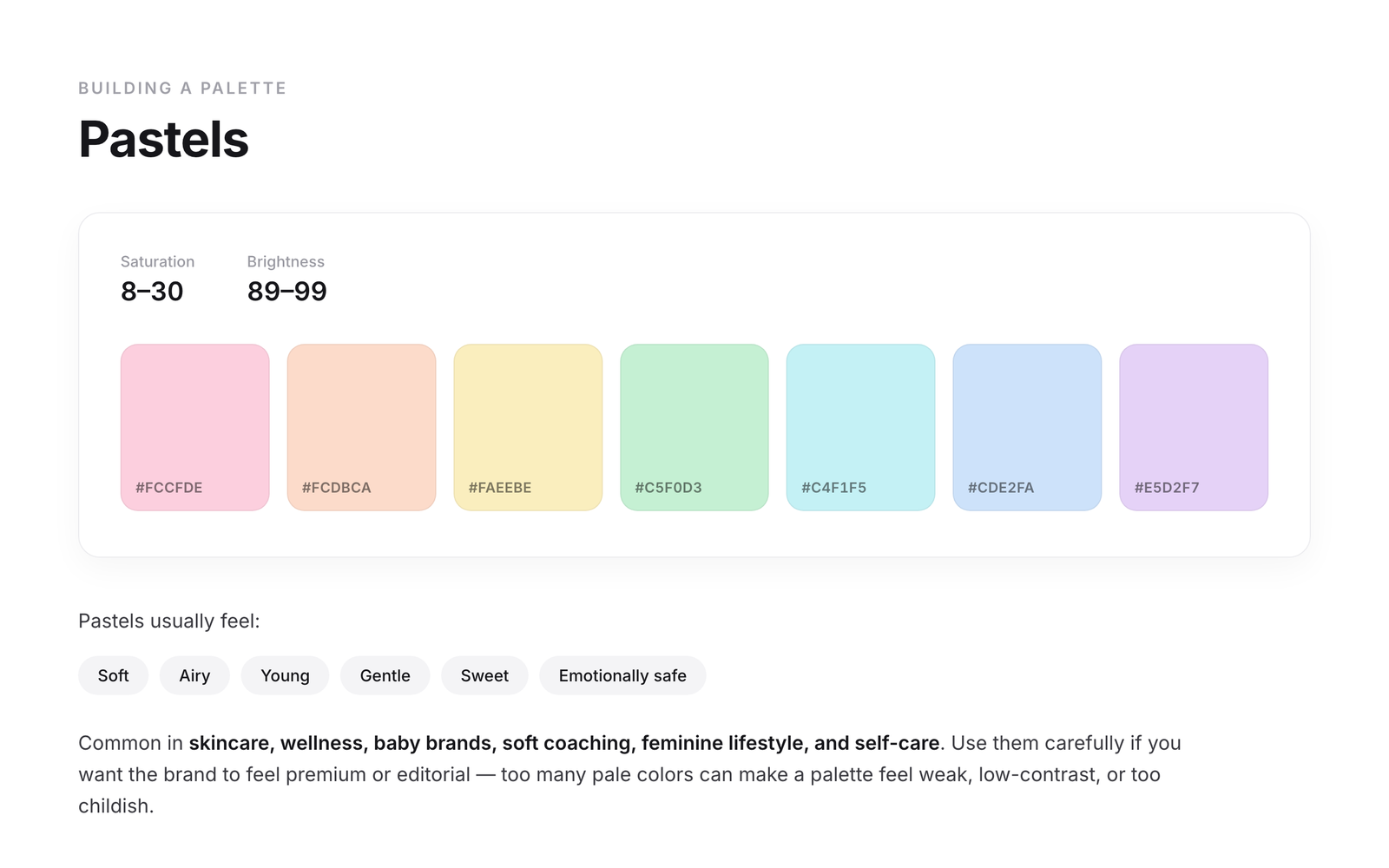
Pastels
Formula:
Saturation: 10–35
Brightness: 86–98
Pastels usually feel soft, airy, young, gentle, sweet, and emotionally safe.
They’re common in: skincare, wellness, baby brands, soft coaching, feminine lifestyle, and self-care brands.
Use them carefully if you want the brand to feel premium or editorial. Too many pale colors can make the palette feel weak, low-contrast, or too childish.
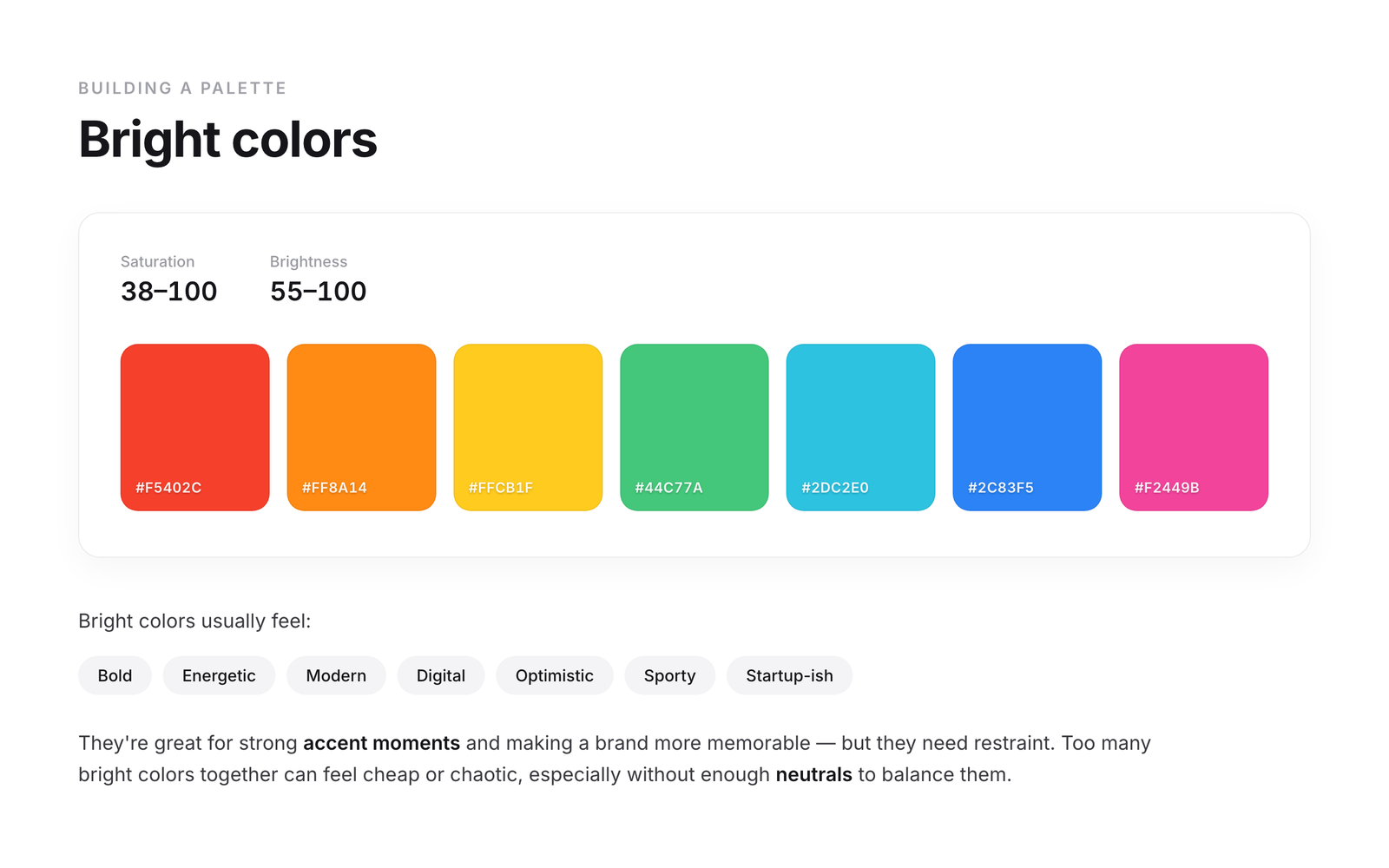
Bright colors
Formula:
Saturation: 38–100
Brightness: 55–100
Bright colors usually feel: bold, energetic, modern, digital, optimistic, sporty, or startup-ish.
They’re great for strong accent moments and making a brand more memorable.
But they need restraint. Too many bright colors together can feel cheap or chaotic, especially without enough neutrals to balance them.
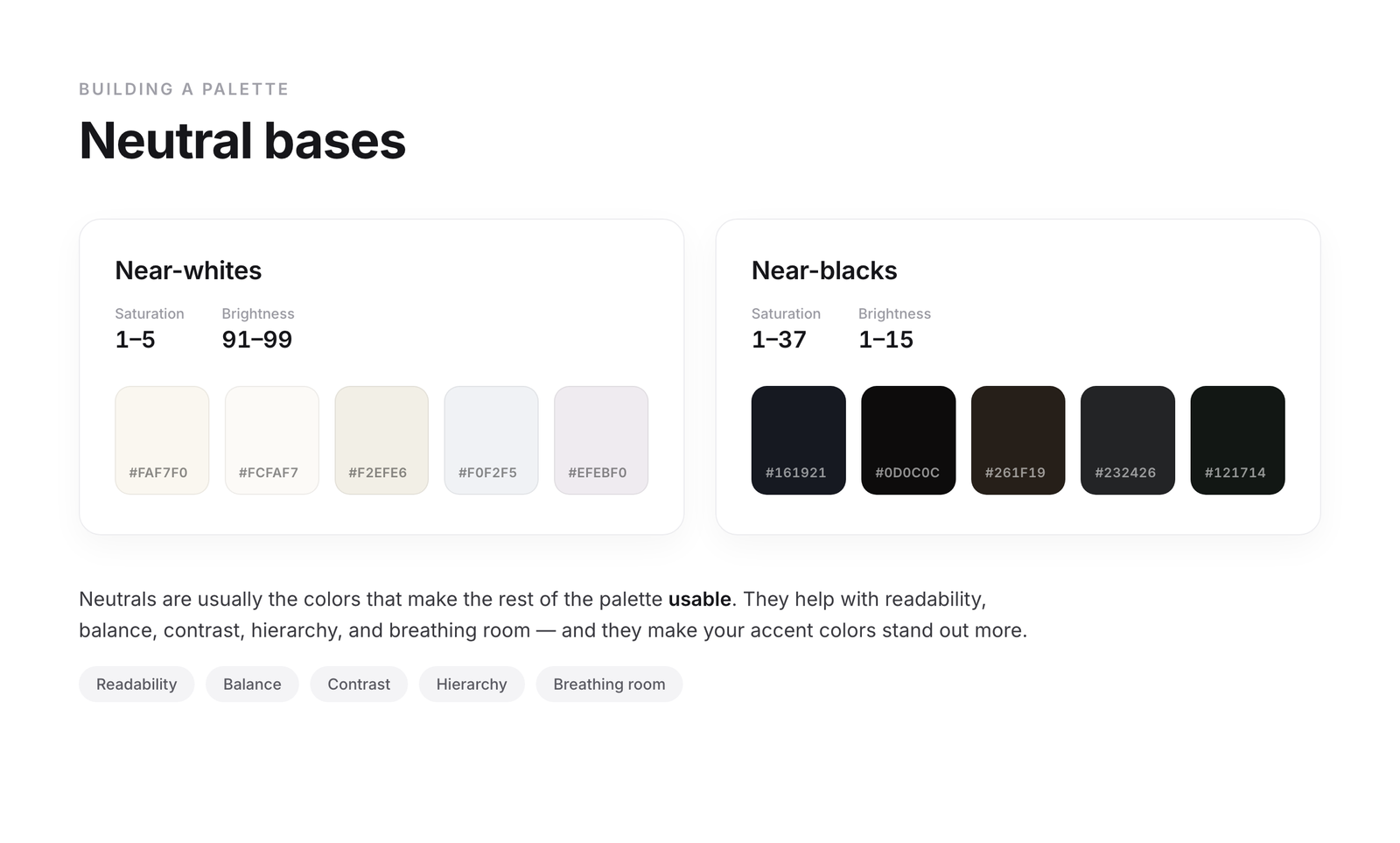
Neutral bases
Near-whites formula:
Saturation: 1–5
Brightness: 91–99
Near-blacks formula:
Saturation: 1–37
Brightness: 1–15
Neutrals are usually the colors that make the rest of the palette usable.
They help with: readability, balance, contrast, hierarchy, and breathing room. They also make accent colors stand out more.
These are your background colors, text colors, grounding colors, and “please let people actually read the website” colors.
The secret thing people forget: your content is part of your palette
This is one of my favorite little brand secrets, and I don’t think people talk about it enough.
Your brand colors are not only the swatches in your brand guidelines. They are also the colors that show up in your website photos, videos, office, clothes, props, reels backgrounds, Instagram stories, Zoom setup, and little everyday content moments.
So when building your color palette, one of the smartest things you can do is look at your actual surroundings.
What colors are already showing up in your content? Are you always filming around greenery? Are your photos usually in warm interiors? Do you work from a creamy neutral office? Are you always holding a matcha? Do you shoot in a bright white studio? Do you wear a lot of pink? Do you use wood, linen, chrome, marble, florals, books, ocean, city streets?
Those colors are already becoming part of your brand whether you meant for them to or not.
So you can work with that.
If you naturally make content around greenery all the time, maybe include a green in your palette. Not necessarily a literal leaf green, but something that makes the content and the website feel connected.
Or you can go the other way around: decide on a color palette based on your target audience psychology, your brand vision, and the feeling you want to create, and then intentionally bring those colors into your real world.
Get office supplies in your brand colors. Choose a notebook, a mug, a backdrop, a scarf, a chair, a blazer, a flower arrangement, a photo studio, a little prop, whatever. This subtle repetition is what makes a brand feel glued together.
When someone goes from your Instagram to your website and the colors feel like they are living in the same world, it looks SO good. It feels intentional without being loud. It makes the whole brand feel more expensive because nothing feels random.
A few rules I personally live by
Never drench backgrounds in bright colors unless you really, really know why you’re doing it.
Never make the website low contrast just because the pale color combination looks “soft.” Soft is not an excuse for unreadable.
Never use too many colors right next to each other unless the whole concept is very intentionally colorful and you know how to control it.
If you use one strong color, ground it with quieter colors around it. That’s what makes the strong color feel chic instead of chaotic.
Don’t choose colors only because you like them. Choose them because they communicate the right feeling and can actually function in the brand system.
Don’t be afraid to adjust a shade slightly for usability. Your brand is not going to fall apart because your cream background is 3% warmer or your beige section is a little lighter.